This morning I had to track down some paperwork for Human Resources. It didn't take very long, but I used it as an excuse to miss the morning session. I'd reached the saturation point, and I really didn't think the morning exercise was going to be all that helpful. Instead, I took care of a couple of things for the office and watched the view from my window.
I sat at the "wrong" table at breakfast. I got tapped to serve during Communion at our closing worship and to give the blessing at lunchtime.
Victor Floyd led closing worship. The pretty much the entire service was sung, including the blessing of the bread and the wine. One of the pastors in attendance sang the verses, and the congregation sang the refrain. That wasn't the only time while I was at the conference that the entire community gathered blessed/consecrated the bread and wine. Monday night and Tuesday night Arris had all of us hold our our hands over the elements as he said the prayer of consecration. At this morning's worship there were three stations, each with a holder and two servers. The holders held a plate of bread and a small bowl of wine. As each person came forward to receive one of the servers would take a piece of bread, dip it in the wine, and place it in the person's mouth. Then the server would lay hands on the person and give a blessing and perhaps a prayer, if the person requested it. After the congregation had been served, the servers and holders served and blessed each other before gathering in a huddle to say a final prayer for themselves.
This is how they do Communion at Victor's Metropolitan Community Church congregation. The practice arose during the height of the AIDS epidemic when it might be the only time in a week when someone with AIDS was touched by another person. I don't think anyone refused the laying on of hands, though Victor said that if it made you uncomfortable to be touched, you didn't have to be, and the blessing would be said anyway.
I forgot to ask Victor where the sung prayer of consecration came from. If I can't find it, I can email him and ask him where to find it.
After lunch, one of the Episcopal folks who drove to the conference dropped me off at the Lakeside Inn where I caught the shuttle to the airport. It saved me a $15 cab fare and gave us a chance to spend a few more minutes in conversation. These personal connections have been the greatest part of attending this conference. We stopped for coffee at the Starbucks in the Safeway. Slot machines in the Safeway. Slot machines in the airport. Slot machines just about everywhere! Of the resort hotels that the shuttle stops at, the Lakeside Inn is the closest to the conference center, and it's the dingiest. I suppose if you're gambling... At least it was clean, and the restaurant had good food (I ate lunch there Sunday).
I have a three hour layover in Salt Lake City, so I'll get some dinner there before catching the red-eye home. Tomorrow counts as a travel day, and Friday will be a Sabbath day.
Peace,
Jeff
Wednesday, October 13, 2010

Tuesday, October 12, 2010
Western Christian Educators Conference - Day 3
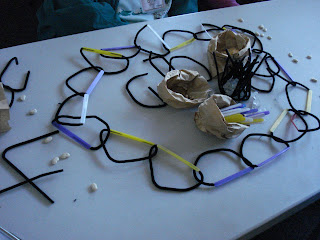
This morning we arrived for the morning session to find four small paper bags on each table. It was obvious that there was stuff in each bag. They were part of this morning's energizer, which was a community building exercise. Each table had to use what was in the four bags, and only the four bags of stuff, to build a model representing their community. That was followed by time to look at what the other tables built. Then every two tables had to combine their models, followed by looking at the other combined tables. Finally, we combined into four tables to build yet another model. What was interesting about our group was that we were the ones willing to move and integrate with the other tables, while they seemed to be more interested in us coming to them. This exercise comes from a Youth Specialties book (Experiential?). Here's the progression of our community model:


Our worship has been primarily music, and Victor Floyd, our worship leader, has been great. We have a variety of songs and styles, some of which he teaches us as we go along. This morning he played "Hallelujah" by Leonard Cohen. A handful of us dissolved into tears. Sometimes songs just hit you that way. You can hear Rufus Wainright's version and see the lyrics on this YouTube video.
Joyce began her talk with some discussion about Harry Potter and how he would have been better off with some Christian education. She told us that it was clear from reading the books that his parents had been churchgoers and believed in God. In the scene where Harry and Hermione go to the churchyard looking for his parents graves, Harry completely misses the clues on some of the gravestones, including his parents', because he doesn't recognize the quotes from Christian scripture.
From Harry Potter she moved to Lewis' Narnia series, specifically The Last Battle. I can't even begin to tell you the context because I've never read the series, not even The Lion, The Witch, and The Wardrobe. I suppose I really ought to read them, so I can get some kind of idea as to why are they so popular and what is it about them that appeals to so many people.
She also read us a rather lengthy quote from a paper by Karen Marie Just that was quite critical of Christian education/Sunday School curricula and the role they played in the development of Moralistic Therapeutic Deism. Someone tracked down the book the essay appears in, and it's $105 on Amazon.com!!!
The morning refrain was, "What we believe about God matters to how we live."
She gave each table a question about God and asked us to come up with three things we believed. My table's question was "Who is the immanent God?" This is what our anwer looked like by the time we got done with it:

An observation from this morning's sessions: I am amused (and sometimes aggravated) those who are sticklers about following directions yet can't follow directions from other people.
After the morning break, Victor spent a half hour talking about hymns. He's picked some wonderful music for us throughout the conference, and not all of it was in the hymnals! He also has a great sense of humor. Lots of good stuff, but the two questions that stick out in my mind are: Is it ethical to lead liturgy that you don't agree with? Is it ethical to lead liturgy the people don't agree with? Interesting questions to ponder, and not just in terms of leading liturgy.
Back to Joyce, who finally began to take us from the theoretical to the practical. We are in eight groups working on presentations about each of the age groups and their pictures of God and ways in which me might teach them about the image of God. We'll be finishing up tomorrow morning.
I've been making an effort both in the morning sessions and at meals to sit with different people. That's not an easy thing for an introvert. But, it's about making connections and getting to know others who are working in the same field. Today I ate lunch at a table of United Church of Christ educators. The conversation ended up being about a new program that's in the process of being released online. Obviously, I didn't have anything to add to that conversation. Still, it's been good for me to make the effort.
This afternoon while I was sitting in my room working on a couple of things, I looked up and saw this:

At one point today I realized I wasn't feeling quite up to par. A slight headache and that just slightly "off" feeling. Then I thought, "Just because you're on the waterfront doesn't' mean that you're at sea level!" Drinking some extra water helped, and by dinner time I was feeling fine.
For the fourth and final workshop session I chose something for me, rather than strictly for work: Small Groups for Big Impact Adult Formation led by Julia McCray-Goldsmith and Lyle SmithGraybeall. Julia I've known for a while through networks related to my job, but Lyle, who works for Renovare, is someone I met here for the first time. Again, I didn't learn a lot of new stuff, but there were some snippets of helpful information.
After the evening workshops, we Episcopalians gathered for Eucharist. Part of me really wanted to bring a Prayer Book, but I refrained. Aris' extemporaneous services have been wonderful. And he asked all of us to lift our hands during the actual prayer of consecration. Nor have they been totally "Aris-led services. They have been community Eucharists. These evening Eucharists have been important to all of us. They have strengthened the connections we are building with each other.
A good deal of what I've been writing in these blog posts about the conference will end up in my report to my team at the office. And I will be copying the Program Directors on that report. Even with the technology available to help us meet online, face-to-face connections are important. Many of the folks I have met here I would not have the opportunity to meet via Skype, GoTo Meeting, or any of the other online communications tools we use. I value those tools, but I also understand their limitations.
I have made valuable connections here, and they are all the stronger for having been made in person.
Peace,
Jeff
Monday, October 11, 2010
Western Christian Educators Conference - Day 2
We spent the morning with Joyce MacKichan Walker talking about the results of the National Study of Youth and Religion that was done in 2002-2003, specifically focusing on the book Soul Searching: The Religious and Spiritual Lives of American Teenagers, by Christian Smith and Melinda Lundquist Denton (Oxford Uni verity Press, 2005). Our table discussions were about our reactions to the data and how it fit with what we observed in our own communities. A lot of it didn't seem to fit, but the majority of those in the study turned out to be conservative Christians, which, of course, skews all the rest of the data. It left some of us wondering just how random the sampling truly was.At least half of our time was in discussion of (Christian) Moralistic Therapeutic Deism, which is the main thesis of Soul Searching
Often Joyce forgets that there are non-Presbyterian and non-reform folks in the room. Not all of us are familiar with the Westminster Catechism, for example. Note to self: Remember this when working with ecumenical groups!
We've been using music from different denominations during worship. Today we used The New Century Hymnal, which is not used by all churches in the United Church of Christ. It is an attempt to use more expansive language about God, and according to our worship leader, when it is used, it often leaves everyone mad.
My first workshop was "Let's Start A Sunday School." I didn't learn very much, and there really wasn't anything cutting edge presented. But it was interesting to see how a small church Sunday School is handled by someone else.
My second workshop was "Using Children's Literature in Sacred Ways." Every book on the table was "secular." No retellings of Bible stories, etc. My book for the workshop was The Three Questions, which is based on a story by Leo Tolstoy. We were asked to read through the book and then think of Scripture that might relate, or how we might use it in our congregations--and not just with children. I thought The Three Questions might make an interesting reading at the end of our service at Grace when Lois gives us a moment of silence to think about how we are going to go out into the world.
The Episcopalians here have been gathering in the evenings to share Eucharist. The one priest amongst us is Aris, who was a classmate of Rob Bloulter's at Berkeley. It has been an interesting experience doing the entire service without a Book of Common Prayer or a leaflet with the service in it. Some of what Aris did was jarring, but it was holy and life giving nonetheless.
(Get out of your left brain, Jeff!)
The office intrudes on the conference:
I've been checking Email a couple of times a day. This afternoon we received one from Toni Daniels. They're consolidating Church Center Staff and opening up another floor to be rented out. The General Convention office will be moving to the second floor, and the Program Staff will be located on the fifth floor. Yes, I'm moving again--the sixth time in the eight years I've been at the Church Center. I won't know details until I go back into the office because Toni wrote that they would be talking with those of us affected by this move during the week. Since I won't be back in the office until next week...
Peace,
Jeff
...[W]e have come with some confidence to believe that a significant part of Christianity in the United States is actually only tenuously Christian in any sense that is seriously connected to the actual historical Christian tradition, but has rather substantially morphed into Christianity's misbegotten stepcousin, Christian Moralistic Therapeutic Deism. This has happened in the minds and hearts of many individual believers and, it also appears, within the structures of at least some Christian organizations and institutions. ...It is not so much that U.S. Christianity is being secularized. Rather more subtly, Christianity is actively being colonized and displaced by a quite different religious faith. (p. 171)My reaction? It's not the first time Christianity has "strayed" along these lines, and it probably won't be the last. And I'm not sure that's really a bad thing.
Often Joyce forgets that there are non-Presbyterian and non-reform folks in the room. Not all of us are familiar with the Westminster Catechism, for example. Note to self: Remember this when working with ecumenical groups!
We've been using music from different denominations during worship. Today we used The New Century Hymnal, which is not used by all churches in the United Church of Christ. It is an attempt to use more expansive language about God, and according to our worship leader, when it is used, it often leaves everyone mad.
My first workshop was "Let's Start A Sunday School." I didn't learn very much, and there really wasn't anything cutting edge presented. But it was interesting to see how a small church Sunday School is handled by someone else.
My second workshop was "Using Children's Literature in Sacred Ways." Every book on the table was "secular." No retellings of Bible stories, etc. My book for the workshop was The Three Questions, which is based on a story by Leo Tolstoy. We were asked to read through the book and then think of Scripture that might relate, or how we might use it in our congregations--and not just with children. I thought The Three Questions might make an interesting reading at the end of our service at Grace when Lois gives us a moment of silence to think about how we are going to go out into the world.
The Episcopalians here have been gathering in the evenings to share Eucharist. The one priest amongst us is Aris, who was a classmate of Rob Bloulter's at Berkeley. It has been an interesting experience doing the entire service without a Book of Common Prayer or a leaflet with the service in it. Some of what Aris did was jarring, but it was holy and life giving nonetheless.
(Get out of your left brain, Jeff!)
The office intrudes on the conference:
I've been checking Email a couple of times a day. This afternoon we received one from Toni Daniels. They're consolidating Church Center Staff and opening up another floor to be rented out. The General Convention office will be moving to the second floor, and the Program Staff will be located on the fifth floor. Yes, I'm moving again--the sixth time in the eight years I've been at the Church Center. I won't know details until I go back into the office because Toni wrote that they would be talking with those of us affected by this move during the week. Since I won't be back in the office until next week...
Peace,
Jeff
Western Christian Educators Conference Day 1
It's after 10:45 p.m. PACIFIC TIME, even though I'm on the shores of Lake Tahoe in Nevada. I've been up since 3:00 a.m. Eastern Time so that I was ready for the 3:40 a.m. shuttle pick up to take me to JFK. 7:00 a.m. flight to Salt Lake City, which is on Mountain Time, followed by an 11:35 a.m. Mountain Time flight to Reno, which landed at 11:45 a.m. Pacific Time. Then I took a two hour bus ride to the Lakeside Inn where I had lunch. Then I took a taxi to the Zephyr Point Presbyterian Conference Center.
It's a beautiful site right on the shores of Lake Tahoe. Here are a couple of views from my room.


And here is my room, which could sleep up to 6 people (three queen-size beds). I have the room, which is almost as large as my apartment, to myself.


This is a multi-denominational conference, but most of the attendees come from reform-type denominations. This evening our keynote speaker Joyce MacKichan Walker focused on Matthew 28:16-20, the Great Commission. It's a little difficult to be a Great Commission Christian(Matthew 22:36-40) amongst Great Commission Christians. Did you know that Bishop Jeffrey Rowthorn's "Lord You Give the Great Commission" is hymn number 429 in the Presbyterian Hymnal?
But she led us through an interesting exercise. Each table of seven was given seven small numbered rectangles with colors and shapes on the other side. Each person at the table took one of the rectangles, copied the number on the back of a sheet of 8 x 11 1/2 white paper, and drew the shapes, enlarging them as best they could using the colors available in the baskets of markers on the tables, on the other side of their sheet of paper. When we were finished, we were to put the small square, color/shape side out, on a sheet of paper with numbered spaces and then put our large copy on a large grid of numbered sheets of paper.
Here's my sheet (I locked my inner perfectionist in the basement!)

Here's what our finished grid looked like:

Here's the original:

While we were doing the drawing at our tables, we were to discuss amongst ourselves the images of God we had as children.
After the main session, there were denominational Meet-and-Greets. Nine of the 10 Episcopalians in attendance gathered in a small chapel to have Eucharist to start off our time together.
More tomorrow. I hope to be tweeting from the conference on @EpiscoChildMin, which should also appear on my office Facebook page Children's Ministries - Episcopal Church Center.
Peace,
Jeff
It's a beautiful site right on the shores of Lake Tahoe. Here are a couple of views from my room.
And here is my room, which could sleep up to 6 people (three queen-size beds). I have the room, which is almost as large as my apartment, to myself.
This is a multi-denominational conference, but most of the attendees come from reform-type denominations. This evening our keynote speaker Joyce MacKichan Walker focused on Matthew 28:16-20, the Great Commission. It's a little difficult to be a Great Commission Christian(Matthew 22:36-40) amongst Great Commission Christians. Did you know that Bishop Jeffrey Rowthorn's "Lord You Give the Great Commission" is hymn number 429 in the Presbyterian Hymnal?
But she led us through an interesting exercise. Each table of seven was given seven small numbered rectangles with colors and shapes on the other side. Each person at the table took one of the rectangles, copied the number on the back of a sheet of 8 x 11 1/2 white paper, and drew the shapes, enlarging them as best they could using the colors available in the baskets of markers on the tables, on the other side of their sheet of paper. When we were finished, we were to put the small square, color/shape side out, on a sheet of paper with numbered spaces and then put our large copy on a large grid of numbered sheets of paper.
Here's my sheet (I locked my inner perfectionist in the basement!)
Here's what our finished grid looked like:
Here's the original:
While we were doing the drawing at our tables, we were to discuss amongst ourselves the images of God we had as children.
After the main session, there were denominational Meet-and-Greets. Nine of the 10 Episcopalians in attendance gathered in a small chapel to have Eucharist to start off our time together.
More tomorrow. I hope to be tweeting from the conference on @EpiscoChildMin, which should also appear on my office Facebook page Children's Ministries - Episcopal Church Center.
Peace,
Jeff
Sunday, September 26, 2010
B Is for Books
I've been reading since I was three or four. I remember sitting on the living room floor with Mom learning basic reading skills from a series clipped from the Chicago Tribune. I arrived for Kindergarten reading, and the school system didn't quite know what to do with me.
Tuesday nights were library nights. After dinner we'd pile in the car and make the five minute drive to the library. Whenever one of us became interested in some topic or another, the stack of books we brought home would mostly be about that topic. Build a solar oven? Go to the library. Make hand puppets? Go to the library. Learn about Asia? Go to the library. I know exactly what Mom did when I went back to college after coming out to the family during Christmas break. Yup, go to the library and find everything she could about lesbians and gays.
My first job was as a page at the library. Wherever I've lived one of the first things I've done is to go to the public library and get a library card. That means that even though I don't go to the library every week, I usually have a pile of books by my bed waiting to be read. And I have a pile of books related to Christian Education, Christian Formation, and children so that I can keep up with the current trends for work.
As if that weren't enough, I also have a virtual pile of books loaded onto my Kindle. And a daily newspaper. I usually use the Kindle on the train and when I'm traveling. I even have a copy of Phyllis Tickle's Divine Hours Pocket Edition on it. It really does make traveling easier, since I don't have to lug around three or four books--even paperbacks take up a fair amount of space and weight in luggage.
So many books, so little time.
Tuesday, August 24, 2010
A is for Apathy
I'm taking a page from my friend and colleague Bronwyn's blog, although I'm going to begin with A and and try to go through in order. We'll see. No promises.
My dictionary defines apathy as:
1. Lack of interest or concern, esp. in matters of general importance or appeal; indifference.
2. Lack of emotion or feeling; impassiveness.
That pretty much sums up my summer.
Part of it has been the weather. Both the heat and humidity outside and the air conditioning inside (without which I cannot sleep when it's hot and humid) sap my energy. And on those days when the weather has been pleasant, my energy has been too sapped to do very much. When I'm not working, I spend a lot time rereading favorite books. That doesn't involve a lot of energy or thinking.
I haven't been practicing much either. By the time I get home most evenings I don't have a lot of energy, having spent it making sure I'm on top of things at work and planning ahead. Most of what's left goes toward minimal housekeeping chores. And since I have no gigs scheduled, practicing is way down on the priority list. Not to mention that I've posted only two entries here so far this summer.
About the only thing I've paid attention to is my diet. While I've not been totally diligent (read: some days have been total disasters in terms of either too much or not enough), I have been slowly shifting my eating habits. For the most part, my meals have been more balanced, and they've been smaller in portion size. As I've been better about my eating, my body has been better at letting me know how it's feeling. Or rather, I'm learning to pay more attention to my body.
I haven't been a total lump this summer. I'm on the planning committee for the 120th Anniversary celebration at my church. A group of friends that hasn't seen each other for several months has been intentional about getting together a couple of times over the six weeks. I've been recruiting for our Education for Ministry (EfM) group, which starts in September (if your in lower Fairfield County and are interested, let me know). I've been making vacation plans for December. And I have been listening to recordings of music I'd like to work on when I start practicing again.
But there is a long list of things I should have done this summer that have gone undone--some important, some not. Most days I look at the list and say "Oh well."
This week I've started to work on getting some of those items checked off.
And I will start practicing again.
As soon as I find the energy.
Monday, July 26, 2010
Maybe Next Year
I won't be attending the National Flute Association 38th Annual Convention next month. I wasn't able to save the money I'd need to fly to Los Angeles and spend almost a week in Anaheim. And last July I spent three weeks in the same hotel for the Episcopal Church's General Convention.
Today Summer 2010 issue of The Flutist Quarterly showed up in my mailbox. The Summer issue always the Schedule of Events for the current year's convention. Of course, I looked. During the first scan, I saw only three workshops I was interested in attending, primarily Zara Lawler's Saturday morning workshop "Interdisciplinary Performance Basics." Zara's workshop at the 2009 convention was a real eye-opener for me, and I regularly read her blog. As much as I like Zara's work and would love to take the workshop, it alone still isn't worth the expense of attending the convention in California.
Each time I looked through the schedule I found something else that interested me. Worth the expense yet? Maybe, but I don't have the money. It took me a long time to get myself out of debt, so I'm not going to participate in something I can't pay for up front. So unless someone hands me a rather large check in the next week, I won't be going to Anaheim.
So, I have some incentive to save for next year's convention, which will be in Charlotte, NC. Is it a coincidence that I'll be in Charlotte in February for network meetings for work and for the National Association for Episcopal Christian Education Directors Annual Conference?
And if I'm going to be down there, maybe I'll rent a car and make the drive west to Asheville and visit Biltmore.
Time to start saving and planning.
Subscribe to:
Posts (Atom)